

Table of Contents
- How wartime sugar rationing began
- Why imported sugar supplies were vulnerable
- How ration books and registered retailers worked
- The typical weekly household allowance
- Sugar, jam-making and preserving
- Everyday home-front life under wartime sugar rationing
- Why rationing continued after 1945
- Sources
- FAQ
- Explore The Ration Room
During the Second World War, sugar rationing changed something as ordinary as a spoonful of sugar into a carefully managed part of family life. From January 1940, shoppers needed coupons, registered retailers and a little forward planning to buy their allowance. The rules reached far beyond the grocer’s counter: they affected baking, jam-making and the way households used seasonal fruit.
Ration books tell this story particularly well. Their clipped coupons and retailer details show how a national policy became part of the weekly shopping routine. They also explain why sugar controls outlasted the fighting and remained familiar to British families long after VE Day.

How sugar rationing WW2 began
For Britain, wartime sugar rationing began as part of the first phase of wartime food control. The National Archives’ ration book resource states that food rationing was introduced in January 1940 and that bacon, butter and sugar were among the first things to be rationed. A separate written answer in Hansard on 1 February 1940 shows how quickly sugar had become a major public issue, with Parliament discussing pre-war consumption and the effect of the new rationing rate.
Sugar was controlled from the opening months of food rationing because it mattered in almost every kitchen and in commercial products such as jam, biscuits, confectionery and condensed milk. Hansard put pre-war consumption at roughly 100 lb per person each year. Under the new rationing rate, that figure was expected to fall to about 75 lb.
Seen from the British kitchen, the start of rationing meant that an ordinary ingredient suddenly became something counted, recorded and controlled. It also meant that households had to learn a new set of habits from the beginning of 1940 onward.
Why sugar rationing WW2 was necessary
Shipping risks and fair shares
The background to wartime sugar controls was Britain’s dependence on imported food. St Albans Museums explains that before the war Britain imported two thirds of its food, including most of its sugar. During the war, German U-boats were trying to sink Britain’s supply ships, so fewer supplies were getting through. The National Archives similarly explains that after war was declared in September 1939, the government had to cut down on the amount of food brought in from abroad as German submarines started bombing British supply ships.
Rationing was therefore about more than scarcity. The government needed to protect limited supplies, keep food on shop shelves and prevent prices from running out of control. As The National Archives explains, the aim was to use food economically while sharing what was available fairly between households and traders.
The coupon system gave households a defined share and allowed retailers to plan for the customers registered with them.

How sugar rationing WW2 worked in shops
Coupons, registration and weekly use
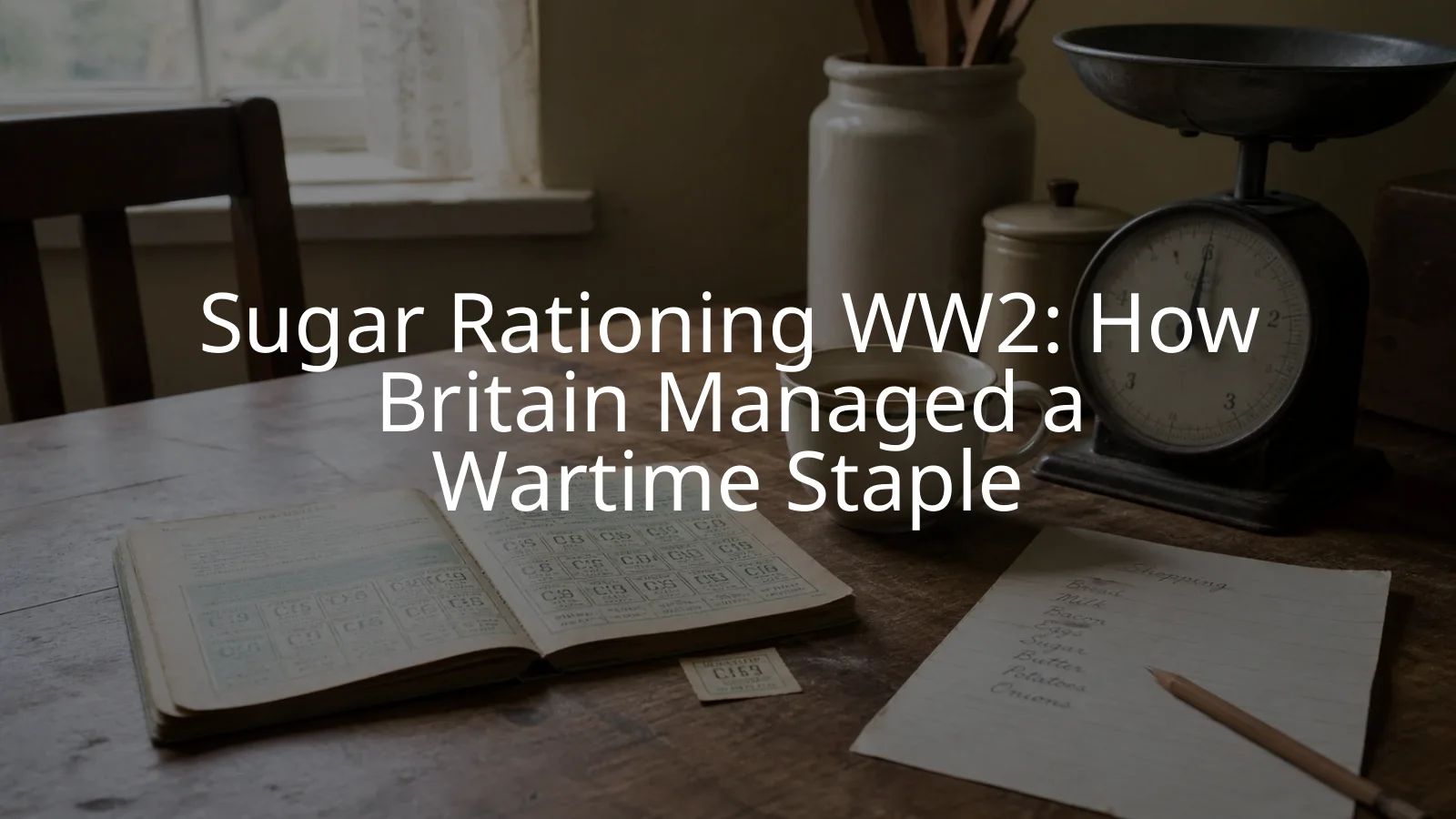
Ration books turned national policy into a weekly routine. Each book contained coupons for controlled foods and included space to name the household’s chosen sugar retailer.
Families registered with particular shops, which kept the relevant counterfoils and received stock for their registered customers. When sugar was bought, the shopper handed over the ration book and the retailer removed the appropriate coupons.
Coupons could not simply be used in any shop. Registration connected each household to named retailers and helped the government direct enough stock to serve their customers. It was bureaucratic, but it gave both families and shopkeepers a measure of certainty.
The book itself was part of daily administration. The National Archives also states that coupons not used in the week for which they were intended could not be used later. In practice, rationing encouraged careful weekly planning. Missing the right week mattered. So did storing the book safely and bringing it to the correct shop.
For collectors, teachers and museums, these details are exactly why ration documents remain so evocative. They show the structure behind ordinary shopping rather than only the headline dates.
Weekly allowances under sugar rationing WW2
Warwick War Memorial lists the basic weekly allowance as 9 oz of sugar per person. For a family, that amount had to cover drinks, baking and any other household use.
The allowance may sound simple on paper, but managing it required choices. Sugar used in tea could not also go into a cake or a batch of jam, so households planned according to their size, tastes and priorities.
Hansard offers another way to understand the scale. It states that the current rationing rate would reduce annual sugar consumption to about 75 lbs per head, compared with approximately 100 lbs pre-war. Together, those sources show that rationing did not eliminate sugar from domestic life, but it clearly reduced it.
Sugar rationing WW2 and home preserving
Sugar was not only for tea and baking. It was also needed to turn seasonal fruit into jam that could be stored for later, making every saved ounce valuable in the wartime kitchen.
The verified sources supplied here show the central place of jam within rationed life. Warwick War Memorial records that jam, marmalade, treacle and syrup were placed on ration in March 1941. Hansard also includes jams among the manufactured articles tied to national sugar consumption. These points help explain why sugar use in the home could not be understood only as a matter of sweetening drinks. Preserving had real value within the wartime kitchen.
Jam, marmalade, treacle and syrup joined the ration in March 1941. Preserving fruit nevertheless remained an important household skill, particularly for families growing produce in gardens or allotments.
For schools, museums and display work, this is often where the subject becomes tangible. A jam jar, a preserving pan, fruit from a garden or allotment, and a ration book together tell a very human story of planning ahead.
Everyday life during sugar rationing WW2
Kitchen routines and preserving fruit
In the kitchen, rationing was felt through dozens of small routines. St Albans Museums notes that the government wanted people to stay healthy and that the radio programme Kitchen Front gave advice on how to stretch rations and use foods in new ways. It also notes that people were encouraged to dig up lawns and grow extra food, with allotments playing a big part in keeping people fed.
That wider pattern matters because sugar controls sat inside a broader culture of home economy. If fruit could be grown or gathered, preserving it became especially worthwhile. If weekly sugar had to be budgeted carefully, then every spoonful had a purpose. Kitchen decisions became more deliberate, from sweetening tea to saving enough for a recipe.
The paperwork became part of everyday life. Ration books had to be kept safe, taken to the correct shop and used in the right week because unused coupons could not simply be carried forward. An administrative system was felt through very ordinary domestic habits.
School learning and museum interpretation
Rationing also lends itself particularly well to education and interpretation. The National Archives presents ration books as classroom resources, and St Albans Museums uses rationing to help visitors think about how much food different people could receive. Its educational value lies in that connection between national events and small, recognisable household decisions.
For a museum table, school session or period display, the story often begins with what a visitor can picture easily: a system intended to prevent shortages, a named sugar retailer, a coupon page, a family deciding what to save for Sunday baking, or fruit being preserved so it did not go to waste. The story is memorable because it joins national policy to ordinary household routines.
Why rationing continued after 1945
The end of the war did not bring an immediate end to sugar rationing. St Albans Museums states plainly that although VE Day in May 1945 meant the end of the war with Germany, it was some time before rationing could be stopped. Warwick War Memorial goes further, noting that rationing in Britain continued for another nine years and that sugar remained on ration until 1953, while ration books were no longer needed only in 1954.
That long post-war tail is an important part of British memory. Families who lived with wartime controls often continued using ration books for years afterwards. The label “wartime rationing” is useful, but the practical experience extended into the post-war years.
Rationing began in January 1940, but its continuation after 1945 belongs to the post-war story. For families still presenting coupons at the shop, however, the change from war to peace did not immediately transform the weekly routine.
Sources
- The National Archives: Ration book
- The National Archives: The need for food control
- UK Parliament Hansard: Sugar, 1 February 1940
- St Albans Museums: Rationing
- Warwick War Memorial: WW2 Rationing Rules
FAQ
When did sugar rationing begin in Britain?
Food rationing was introduced in January 1940, and sugar was among the first foods to be rationed, according to The National Archives.
Why was sugar rationed in wartime Britain?
Britain relied heavily on imported food, including most of its sugar. German attacks on supply shipping reduced deliveries, and rationing helped prevent shortages and support fair distribution.
How did people buy sugar during wartime rationing?
People used ration books with coupons and had to register with a retailer for rationed foods. The shopkeeper removed the correct coupons when rationed food was bought.
What was the weekly sugar ration?
Warwick War Memorial lists the basic ration for one person per week as 9 oz of sugar.
Did sugar rationing end in 1945?
No. The war ended in 1945, but rationing continued afterwards. Warwick War Memorial states that sugar remained on ration until 1953.
Explore The Ration Room
The Ration Room is a UK-based company dedicated to preserving the look and feel of everyday life during the 1940s. Its replicas are created from original packaging and government-issue designs, making them especially useful for display, education and theatre.
If you are interpreting wartime sugar controls for a classroom, museum table or home-front display, a few carefully chosen items can help visitors see how the system worked in practice:
- Blitz Ration Book – £4.50
- Ration Book Holder – £3.75
- Ration Book & Clothing Set – £9.75
- Apple & Rhubarb Jam – £4.50
Together, these pieces help turn an abstract set of rules into a display that visitors can understand at a glance.